The Alphabet Soup of Search
If you have been in a marketing boardroom recently, you have likely heard a flurry of new acronyms thrown around…
AEO (Answer Engine Optimization). GEO (Generative Engine Optimization). SGE (Search Generative Experience). LLM Optimization.
It is enough to make any CMO’s head spin.
For two decades, the goal was simple: rank number one on Google. We optimized for a specific set of keywords, built backlinks, and tracked our position on a linear list of 10 blue links. But the introduction of Large Language Models (LLMs) like ChatGPT, Claude, and Google’s Gemini has fundamentally broken that model.
We are shifting from a "search" economy to an "answer" economy. According to Gartner, traditional search engine volume is predicted to drop by 25% in 2026, with users shifting their intent to AI chatbots and virtual agents.
At Beyond Agency, we cut through the jargon. Whether you call it AEO, GEO, or SGE, it all points to one singular goal: AI Visibility.
AI Visibility is not just about being found in a list; it is about being synthesized into the answer. It is the difference between a user searching for "best CRM software" and browsing ten different tabs, versus a user asking ChatGPT, "What CRM should I use for a small real estate agency?" and getting a single, definitive recommendation.
If you are not that recommendation, you are invisible.
In this guide, we will dismantle the dangerous myth that "good SEO is enough" for AI, explore the massive operational shift required to win in this new landscape, and provide a roadmap for building a brand that machines trust as much as humans do.
What’s the Difference Between AEO & SEO? (Traditional SEO vs. AI Search)
To understand how to win, you must first understand the battlefield.
Traditional SEO (Search Engine Optimization) and AI Visibility (AEO/GEO) share DNA, but they are different species. They are distinct services that require distinct strategies.
Traditional SEO: The Librarian
Think of traditional Google Search as a librarian. You ask for a book on "marketing automation," and the librarian points you to the correct aisle and shelf. They don't read the book for you; they just ensure you find the most relevant resource based on the label (keywords) and popularity (backlinks).
- The Mechanism: Information Retrieval.
- The Goal: Traffic (Clicks).
- The Metric: Rankings & Click-Through Rate (CTR).
AI Visibility: The Professor
AI Search is like a professor. You ask the same question, and the professor has read every book in the library. They synthesize the information, filter out the noise, and give you a direct answer. They might cite a source, but the value is in the answer, not the list.
- The Mechanism: Information Synthesis.
- The Goal: Trust (Citations/Mentions).
- The Metric: Share of Model (SoM) & Brand Sentiment.
The Technical Shift: From Strings to Things
The shift from SEO to AI Visibility is a shift from "Strings" to "Things."
- SEO relies on "strings" of text (keywords). If you have the words "best running shoes" on your page enough times in the right places, you rank.
- AI Visibility relies on "things" (entities). The AI understands that "Nike" is a Brand, "Air Max" is a Product, and "Running" is an Activity. It maps the relationship between these entities in a vast Knowledge Graph.
If your brand is not clearly defined as an authoritative entity on a specific topic, the AI cannot confidently cite you.
The "Just Good SEO" Myth: A Dangerous Oversimplification
There is a prevalent narrative in the industry right now: "Don't worry about AEO or GEO. It's basically just good SEO. If you write high-quality content, the AI will find you."
This is true, but it is a dangerous oversimplification.
While creating high-quality content is the prerequisite for entry, relying on it entirely is like bringing a knife to a gunfight. The criteria AI models use to select sources are far more rigorous than traditional search algorithms.
Research from Princeton University highlights that LLMs prioritize "consensus" and "corroboration" over simple keyword relevance. If you say you are the "best agency in London" on your website, Google might believe you if you have enough links. But an AI model scans Reddit, G2 reviews, LinkedIn discussions, and industry journals to verify that claim.
Relying on "standard SEO" ignores the fact that AI models are not just indexing your site; they are judging your reputation.
The Operational Reality: Why You Need Two Distinct Strategies
Achieving AI Visibility is operationally heavier than traditional SEO. It requires a fundamental shift in how your marketing executes. Operationally, doing GEO well is a completely different beast.
This is why we treat AI Visibility and SEO as separate, yet parallel, service lines. Here is the operational reality of why specialized attention is required:
1. Your Outreach Must Scale (Volume & Velocity)
In traditional SEO, landing one high-DA link (like Forbes or TechCrunch) could sustain your rankings for months. In the AI era, you need volume.
- The Shift: AI models thrive on patterns. A single mention is an anomaly; frequent mentions are a pattern. You need to do more outreach to establish a pattern of authority.
- The Strategy: It’s not just about guest posts anymore. It’s about appearing in newsletters, podcasts, and niche communities simultaneously. This volume of outreach is often impossible to manage manually, which is why we recommend implementing marketing automation to reduce costs while increasing the velocity of your PR efforts.
2. Your Monitoring Becomes Complex
Tracking success used to be easy: Are we #1 for 'buy red shoes'? Yes/No. Now, you have to track AI Visibility.
- The Shift: You need to know if ChatGPT cites you when someone asks, "Who makes the best red shoes?" This requires new tools and manual testing across multiple LLMs (GPT, Gemini, Claude, Perplexity).
- The Solution: You have to track "Share of Model"—how often your brand is the cited source. This is far more complex than standard rank tracking, requiring a robust system for tracking Google rankings and SEO tools that can handle the nuance of generative answers.
3. Placements Must Be Specific (Source Data)
Domain Authority (DA) is no longer the only metric that matters. You now have to pick specific sites that LLMs use as a source.
- The Shift: A link from a high-DA site that blocks AI crawlers (via robots.txt) is useless for AI Visibility. Conversely, a link from a lower-DA site like a specialized subreddit or a public documentation hub (like GitHub or Stack Overflow) might be highly valuable because LLMs over-index on these "human discussion" platforms.
- The Strategy: We identify the "seed sets" for major AI models—Wikipedia, Reddit, LinkedIn, and major news publishers—and prioritize visibility there.
4. Reporting Requires New Metrics
You will have to explain entirely new metrics to your stakeholders.
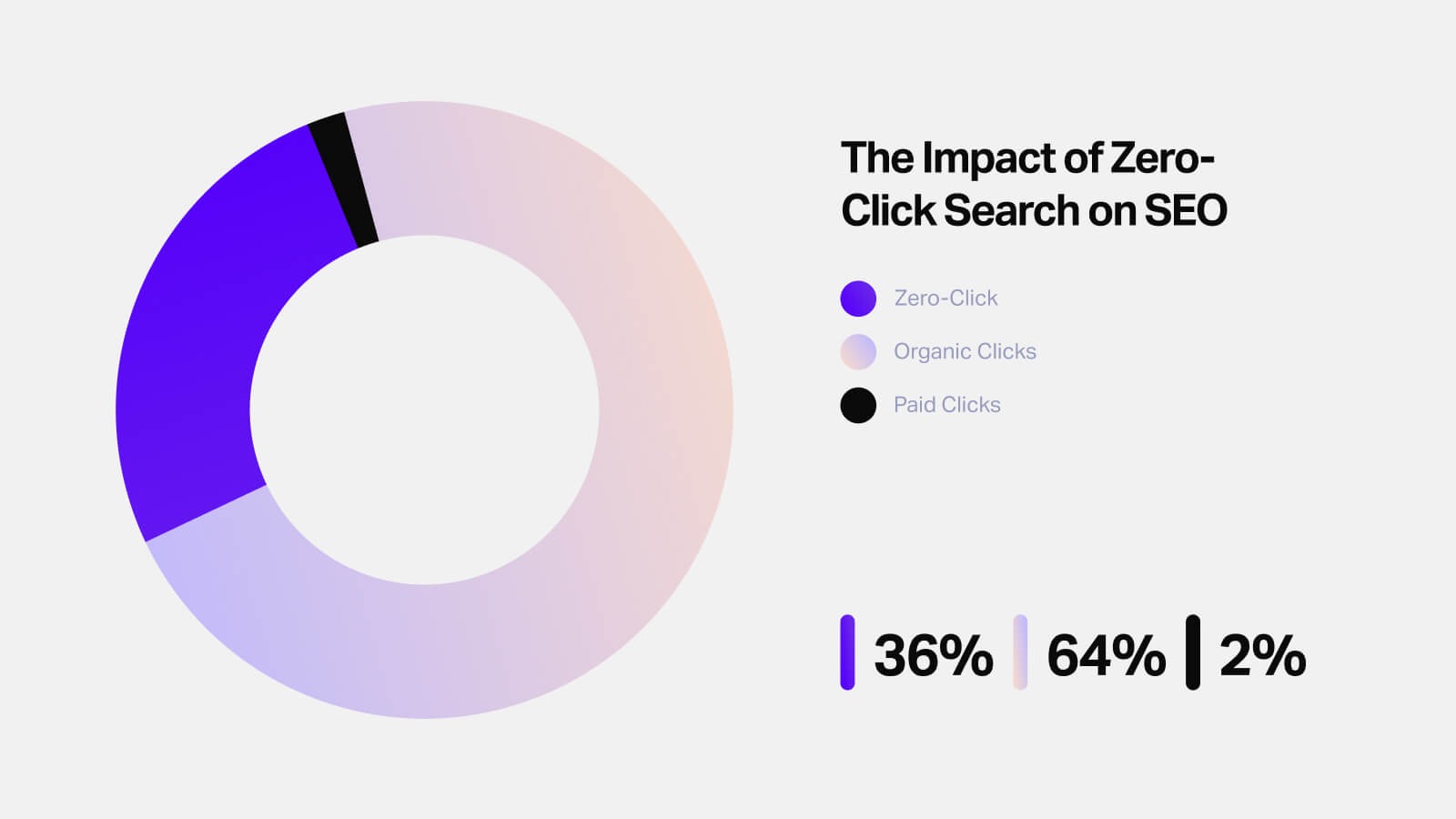
- The Shift: "Traffic" might go down while "Revenue" goes up. This is because AI provides the answer directly (Zero-Click Searches). A study by SparkToro suggests that even way back as far as 2020, well over 60% of Google searches ended without a click! If a user gets the answer "Beyond Agency is the best choice" from ChatGPT, they might go directly to your homepage rather than searching for you.
- The Challenge: You must understand that a drop in organic traffic is not a failure if it correlates with a rise in direct traffic and branded search volume.
5. Content Must Be Dual-Coded
Creating content in the era of AI search is two-fold.
Your content team can no longer just write for humans and Google’s AI algorithm (which favoured human-friendly content). They must ensure that content is helpful for humans AND bots.
- The Shift: Humans like stories; bots like structure. A beautifully written narrative essay is hard for an AI to parse.
- The Strategy: Structure your content with clear H2s/H3s that ask and answer questions directly. Use bullet points, data tables, step by steps, and "Key Takeaway" summaries. This "Dual-Coding" ensures the human enjoys the read while the bot can easily extract the facts.
6. Signals: Brand Mentions Over Links
The focus is shifting from "hyperlinks" to "brand mentions".
- The Shift: Google needed a blue hyperlink to crawl from Site A to Site B. An LLM just needs to "read" the text. If The New York Times mentions "Beyond Agency" without a link, an LLM still processes that as a massive authority signal.
- The Strategy: Digital PR campaigns that generate "buzz" and unstructured mentions are now arguably more valuable than silent link-building campaigns.
The Hybrid Model: Why You Must Do Both
It’s critical to understand that AI Visibility does not replace an SEO strategy. They serve different phases of the user journey.
- Transactional Queries (SEO): When someone wants to buy, they will still likely use a search engine to find a product page. "Nike Air Max size 10" is a Google Search. The user is looking specifically for this item and wants to buy.
- Informational Queries (AI Visibility): When someone wants to learn or decide, they will use an AI. "Which running shoe is best for marathon training?" is a ChatGPT question. A user is asking an AI platform to do the heavy-lifting for them (the research) and provide an answer on the spot before deciding to buy.
Crucially:
Brands that ignore AI Visibility will lose the "Top of Funnel" - the research phase.
Brands that ignore SEO will lose the "Bottom of Funnel" - the checkout phase.
To dominate your market, you must run these strategies in tandem. Hit users where decisions are made (AI generated answers) AND where purchases are made (Google results).
Pillar 1: Entity Optimization (Who Are You?)
You need to explain to the AI who you are. This is done through Schema Markup and Knowledge Graph optimization.
- Organization Schema: Ensure your homepage has robust Organization schema that links to your social profiles, "SameAs" properties (Wikipedia, Wikidata), and founder information.
- About Page: Your About page is no longer a vanity page; it is a data source. Clearly state what you do, who you serve, and where you are located in clear, unambiguous language.
Pillar 2: Citation Authority (Who Vouches For You?)
This is the "Digital PR" element. You need third-party validation.
- The "Co-Occurrence" Concept: You want your brand name to appear alongside keywords related to your industry. If "Beyond Agency" frequently appears in text alongside "AI Marketing" and "Automation," the AI learns to associate those concepts.
- Verified Stats: Models are more likely to cite sources that provide unique, data-backed evidence. Don't just share opinions; publish original research and statistics.
Pillar 3: Technical AEO (Can You Be Read?)
This is about formatting.
- Q&A Format: Dedicate sections of your content to direct Q&A. (e.g., "What is the cost of AI marketing?" followed immediately by "The cost of AI marketing typically ranges from...")
- Data Tables: LLMs love structured data. Whenever you are comparing tools or services, use a table - it’s much easier to be quoted in generated responses.
Conclusion: Adapt or Disappear
The operational load of AI Visibility is heavy, but the cost of inaction is heavier.
As search engines evolve into answer engines, the "10 blue links" are losing their monopoly on attention. If your content strategy is still built solely for 2015-era Google, you are optimizing for a ghost town.
Yes, good AEO/GEO might be a reflection of good SEO, to some extent. But as we have outlined, it’s a completely different beast. It requires a holistic approach that blends technical precision with aggressive digital PR and brand building.
The winning brands of the next decade will be those that treat AI Discoverability as a distinct, primary channel, running in parallel with their SEO efforts.
Ready to future-proof your visibility?
Start by understanding the new landscape. Read our deep dive on what Answer Engine Optimization is and learn how to position your brand as the definitive answer.
FAQs
What is the difference between SEO vs AEO and SEO vs GEO?
Whilst Search Engine Optimization (SEO) refers to the traditional route of ranking on Google’s Search Engine Results Page (SERP), Answer Engine Optimization (AEO) generally refers to optimizing content to appear in "featured snippets" or voice search results (think of voice assistants like Siri or Alexa). Generative Engine Optimization (GEO) is a newer term specifically referring to optimizing for Generative AI models like ChatGPT and Google's SGE. Both fall under the umbrella of AI Visibility at Beyond.
Does schema markup help with ChatGPT and AI LLMs?
Yes. While LLMs consume unstructured text, they are often trained on Common Crawl data which parses the web. Structured data (Schema) helps clarify context, relationships, and entities, making it easier for the model to "understand" and confidently cite your content.
Can I track my ranking on ChatGPT?
Yes, but in the traditional sense of “rankings”. We use dedicated platforms that allow laser-precise prompt tracking, share of voice and AI sentiment - basically, exactly what prompts your brand is mentioned in, and how favourably the LLMs view you. Working with us, we’ll have the exact visibility of your brand across AI search engines.
Is AI Visibility more expensive than SEO?
It can be. However, the ROI can also be higher because the traffic generated from AI citations is often "high intent." A user who asks for a recommendation and clicks your link has essentially already been "sold" by the AI.
How do I prepare my content for AI visibility?
Focus on "Information Gain." Google's SGE (like Google’s AI Overviews) prioritizes content that adds new information to the web, rather than just repeating what is already there. Add unique quotes, original data studies, and contrarian viewpoints to stand out.

Just a heads up, some of the links in this article may be affiliate links, meaning we may make a small commission on any sign-ups or purchases for the tools we recommend.